Message to Children in Congo

I was invited yesterday by Bienve, our host in Congo almost a year ago (in February), to send a message to the children at an upcoming feast (on Christmas), and I know it was a request for funds for this feast, and that is a fair trade. I feel good about providing funds and about sending a blessing.

Click here to read a prior post about Bienve Kamwendo, and here and here to read about my visit to this refugee camp.

I cannot cover the entire meal; if you would like to contribute even a small amount to this meal for hundreds of children in the refugee camp I visited, please see the purple box below. Money goes much farther in Africa, and the meal will be simple – rice, beans, cabbage, and a small amount of meat.

Here’s my Christmas day message to the chidren:

Last year it was a blessing for me to meet you, to sing with you, to watch the games and the dances, to touch your hands and to smile into your beautiful faces.

I will never forget the blessing of visiting you and finding your open hearts.

Don’t forget your sacred ways from your ancestors.

Remember the dance and the songs and the foods and your ancestral lands.

Don’t forget the stories that your parents tell you, and be sure to remember the names of your elders and ancestors.

I hope you will work hard to make this world a better place for all people.

See the good in others if you can. Sometimes it’s hiding, but it’s there most of the time. You will know. You will be able to feel it.

Hold a vision of a good world full of good people. I am praying for this, and simply trying to be good myself. 

Let us all love our families and our neighbors and ourselves.

Don’t forget to love yourself.

When you are in a dark time, when you are struggling and sad or angry or hurt, reach out to the light of God, to the light of your ancestors and your loved ones, to Mother Earth, to the Sun and the Sky and the Water, and that which is closest to you. There is always a way to find comfort, whether inside yourself or outside yourself or in others. Quiet your mind and reach inside yourself to find out what you need to know, how to find the comfort, or what steps to take. This is the way to live life – for all of us.

I send you much love.

From the Mzungu, Annie, mother of Jeff who works with Bienve.

To contribute any amount to this meal, contact me at 8hummingbirdway@gmail.com

Would you like to know more about the nonprofit organization created by Bienve Kamwendo in Goma – Remember Youth for Change? https://www.facebook.com/rememberyouthforchange

Would you like to get blog posts sent directly to your email inbox? Subscribe below.

Potato Field, Allies, and “Thunder”

The Africa Posts

We returned to the van and drove on the central road to park by a large potato field on a hill. Near the van, more land was being tilled by some older boys of the refugee camp. It was clearly very hard going.

This camp had been in existance at least long enough to grow a crop of potatoes. Bienve had told us that an area of potato plants (out of sight, over the hill) had been dug up and taken recently. He said he did not blame the perpetrators; he knew that hunger drove them. However, it was a loss for the community.

The caring presence of Bienve can be seen here, in a video of displaced persons from one of the camps in Goma, working in the potato fields, creating agribusiness.

Beinve and my son walked up the hill to see the gardens beyond, and I stood by the working boys. The photographer who had been traveling with us leaned on the van, along with 2 men who had been child soldiers (1 was the driver). There was a steady trickle of children walking along the road and I wondered where they were going to and from. I smiled and said “bonjour,” and I soon had another group surrounding me. I felt a little closed in, and this group felt different than the walking group from earlier. I think it was my difference, my skin color, that attracted them for the most part. I heard the word Mzungu (meaning white person) a few times. There were no very young children, and it seemed like an elementary school crowd. I wonder now, whether there was some sort of informal schooling set up as well as the one we visited this morning. These children had no uniform, but I sensed they had purpose. Several said “money,” which I ignored, as I had been advised.

I reached out in my mind for some French words that I could say and after some faltering attempts I arrived at the phrase “Tout les enfants sont bon,” which means “All children are good.” The children agreed with n heads nodding. There was warmth and smiles. It may have been that I was a bit tired or depleted; it may have been that these children had less need. I learned that the level of need is much greater if one is a very recent refugee.

After maybe 10 minutes, a man came along to shoo away the children. I thought it was the photographer; he had a similar build. I didn’t like the fact that he sent them off unceremoniously, but I was in a mode of acceptance about choices made around me while I was in another culture in another part of the world.

I stepped to the other side of the road to talk with the man, who seemed to have something to say. There was some back and forth in English and French and after a few minutes he started asking me for money. I said no; I said I don’t have any, but why would he believe that? (My son was handling funds; the exchange rates were a bit confusing for me.) He persisted, and I glanced over to the van where my 3 friends were still leaning. I realized this wasn’t the photographer I was talking to. I left him and walked over to join them, leaning on the van until our next move.

I felt very comfortable with these men from Remember Youth for Change. https://www.facebook.com/rememberyouthforchange

The photographer was clearly a fan of mine. I had noticed him photographing me at various times. I had taken to smiling and pointing to my son as the main event – which he definitely was. I felt he (the photographer) was a person who saw value in my warmth, which I tend to offer easily. My son is the one, however, who cares enough to create change and to make sure the corporate funds he controls are used well – and expends a great deal of energy understanding what is needed in various parts of the world.

The 2 men who had experienced being child soldiers also have my heart, especially the one who was the driver. I will return to him another time.

At one point during this visit I heard thunder. I believe it was when we were standing by the potato field. I did not find out more until we returned to the US; at the time, it was kept from me that this sound was actually artillery fire. I never felt unsafe when I was in Goma or the surrounding area, but later it was explained to me that all was not as I experienced. I know no more about this and it is not my area of interest. Except that the occupants of the refugee camp have had to contend with this instability along with all of their loss.

Would you like to know more about Goma’s nonprofit Remember Youth for Change? https://www.facebook.com/rememberyouthforchange

Visiting homes and walking in the refugee camp

The Africa Posts

We drove deep into the camp, perhaps another half mile, parked, got out, and started to walk around the “homes.”

“UNHCR, the UN Refugee Agency, provides emergency protection and assistance to keep them safe, including shelter, access to clean water, food, medical care and help to reunite families.” Based on my limited experience, the refugees you will see in the photos of this website have had showers, new clothing and more food than the people I met. https://www.unrefugees.org/refugee-facts/?gad_source=1&gclid=Cj0KCQiAoeGuBhCBARIsAGfKY7xSF1MSr_Vv3dR7Hap0A6stsKZcbOWj-jw958SWNJdWD0zMDGeL5H8aAnmwEALw_wcB&gclsrc=aw.ds

I am glad to hear about the clean water, food and medical care – and the reuniting of families. I didn’t see any of that, although I did use the sanitary facilities, visited some individual shelters and one larger structure designated as a church.

The tiny homes, about 5′ X 5′, were the main substance of the camp. We entered 3 families’ homes on this day. Although the website shows homes with thatched roofs, these homes were all wrapped in white plastic (like Tyvek) – sides and ceiling – with a door cut out, and the same plastic covered the home. There were white plastic room dividers inside, separating the sleeping area, with one or two mats, from the empty rest of the shelter. That’s it. There were no clothes in evidence aside from what the people are wearing. In one home I saw a small bowl of stems with leaves, but most of these shelters were completely empty aside from the sleeping mats in the sleeping room, 1-2″ high. Some of these mats had frames of some sort, and some seemed to be a pile of fabric.

We walked through the maze of these small cube homes. They stretched on and on. The ground in much of Goma, and in this refugee camp, was made of lava from a volcanic eruption in May 2021. The rocks and dust from the residue of that eruption was not easy to walk on. As an older person, I had to watch every step. The ground was hard and uneven; I could perceive the flow from 3 years ago.

Bienve, director of Remember Youth For Change https://www.facebook.com/rememberyouthforchange guided us left and right; he had secured permission for us to enter 3 homes. The first 2 were simple 2 room units and one had the bowl of stems + leaves I mentioned. The third home was the same size as all the others, but had been divided into 3 rooms. The residents here were a very pregnant very slim woman and her 4 or 5 small children. It was noted that there would soon be an additional resident. I tried to talk to the woman, but she was not responsive. (My French is not great and I don’t know her familiarity with French.) She seemed overwhelmed. I slipped my simple wooden beaded bracelet from my left arm onto her right one and there was an instant of silence. It wasn’t something I thought out, just an “instinctual” act, although I have thought of it many times since. I hope there were trades she could make using my simple gift. Perhaps this is unrealistic. I have no idea of the culture of the camp. What has value (each bead?).

After the visits, we continued on. At one point my son, a soccer player, came across a few boys with an almost unrecognizable brown soccer ball. He gestured to engage with them/challenge them, and the group of 4 or 5 moved in an animated way across the rough lava ground for several minutes.

As for me, I have always been a lover of children. And there was no shortage of children – everywhere! I offered my smile. And the children responded. They recognized my genuine smile and allowed themselves to be drawn to me. Smiles, laughter, openheartedness. There was talk – mostly me saying “Je ne comprends pas,” (I don’t understand) but sometimes I would come up with a word “hand,” “foot,” “friend,” “amour.” I wish I had thought of “song.” I would have loved a song, just from the children. I did say my name occasionally and asked theirs which I didn’t retain at all. After a few more minutes of walking along, I had a large group of children around me touching me, 2-3 holding each hand/arm. For me, this was a delight beyond all others. They read my heart, returned my smile, and I laughed with them and was even more careful with my steps on the uneven ground.

My son and Bienve were maybe 30 ft ahead and they stopped every few minutes. I would do my best to catch up. A couple times I lost sight of them, but then I saw a flash of my son’s shirt down the row between some shelters, and turned that way.

Most of the women we passed smiled at me now, where there faces had been empty when we drove into the camp. I became more comfortable and said a timid and warm “Bonjour” to each woman we passed.

This was the highest joy of my experience in Africa. Children surrounding me with open hearts. The open warm smiles of mothers in loss. A meeting and connection of humanity, of laughter and smiles – and simple joy and fullness for me.

These are the connections one can make: a soccer challenge, smiles, the gift of a bracelet. (It was perhaps a help that we wouldn’t have been able to communicate with language.) These gifts come from an openness on both sides to engage as humans. There is giving and receiving on both sides and true connection results, even if only for an instant.

When I say this was “the trip of a lifetime,” – it is these moments I return to.

My son had said he came on the journey this year with a specific hope to reconnect to his inspiration. The nonprofit work for him had lost something. I felt it was the human connection. He was very involved in the assessment of the funded work, the local organization and local leaders who had secured help and funding, as well as discussion future plans. On this day – having engaged with a soccer ball and several youths, he decided that he would purchase 2 soccer balls that evening and bring them to our outing the next day at the larger refugee camp outside of Goma. (His first connection to Africa was through bringing soccer to a remote village in Uganda.)

Just before we left, Bienve brought a woman over to the vehicle who, he said, would give away some of my gifts, more to the pregnant mother, and some to others. I had a pair of glasses (I had more at home) some scarves, a turquiose stone, some earrings, a feather, some hair clips, I can’t recall what else – and he allowed me to give them to her and save the rest for tomorrow’s refugee camp.

Deep thanks to my friend who said, when she heard I was going to Africa, “What gifts will you bring?”

One last thought. Although I did not feel a personal connection with the pregnant woman, I have thought of her often. I hope that the child was planted in her womb by her mate, who she is without, at least for now. Perhaps forever.

I know there will be additional burden with the coming of this child. I hope there is some blessing for her as well.

My son says there is nothing I can do for her specifically, that I can donate to Remember Youth for Change https://www.facebook.com/rememberyouthforchange or to his (my son’s) organization that helps so many.

But I am more of a one to one person. I keep thinking of a personal sponsoring for this woman and for one other person I met in Congo.

My son would say that I would risk unwise use of any funds provided, and I know this is true.

There is more to tell of this visit.

Would you like to get blog posts sent directly to your email inbox? Subscribe below.
First Refugee Camp – School Visit

The Africa Posts

Our host, Bienve, and staff from the nonprofit organization Remember Youth for Change https://www.facebook.com/rememberyouthforchange drove us to the refugee camp.

Our first stop was at the school. This school is a community school, and the staff found a way to expand and meet the needs of the displaced children as well as those who already attended. The teachers teach the local children in the mornings and then teach displaced children from the camp in the afternoons.

The afternoon class is large from the camp, and the students only go to school if their parents approve their attendance. There are many many children in the camp – and about 30 lined up for new shirts. There may be more who attend. I’m not sure how large the entire afternoon class is, but we only had about 20 shirts to hand out.

Most displaced parents do not want their children to attend school. From what I know, formal education is not part of a tribal lifestyle.

I’m glad for the rule about school being a parental decision; when we schooled the native children in our country, the parents did not get to approve the decision. After forcing Native Americans from their tribal lands, our forefathers then took their children from the broken tribes – and “schooled” them (often in boarding schools) to conform to European/American religion and culture. The children were not allowed to use their given names or speak their native languages. [Read The Education of Little Tree if you want to know more about this.

Here of course, the story is different. An external military unit forced these people from their tribal lands, and transformed them into refugees. The schooling is a generosity, from what I can tell. The people still sing their songs, keep their names, sustain their tribal identities, and go home to their mothers* and siblings.

I know that Bienve respects the tribal ways.

Regardless of intention, the tribal ways and the tribal closeness to and alliance with Mother Earth has been shattered, along with the connection to ancestors.

And these children are going to have to navigate the dominant culture in DRC (Congo).

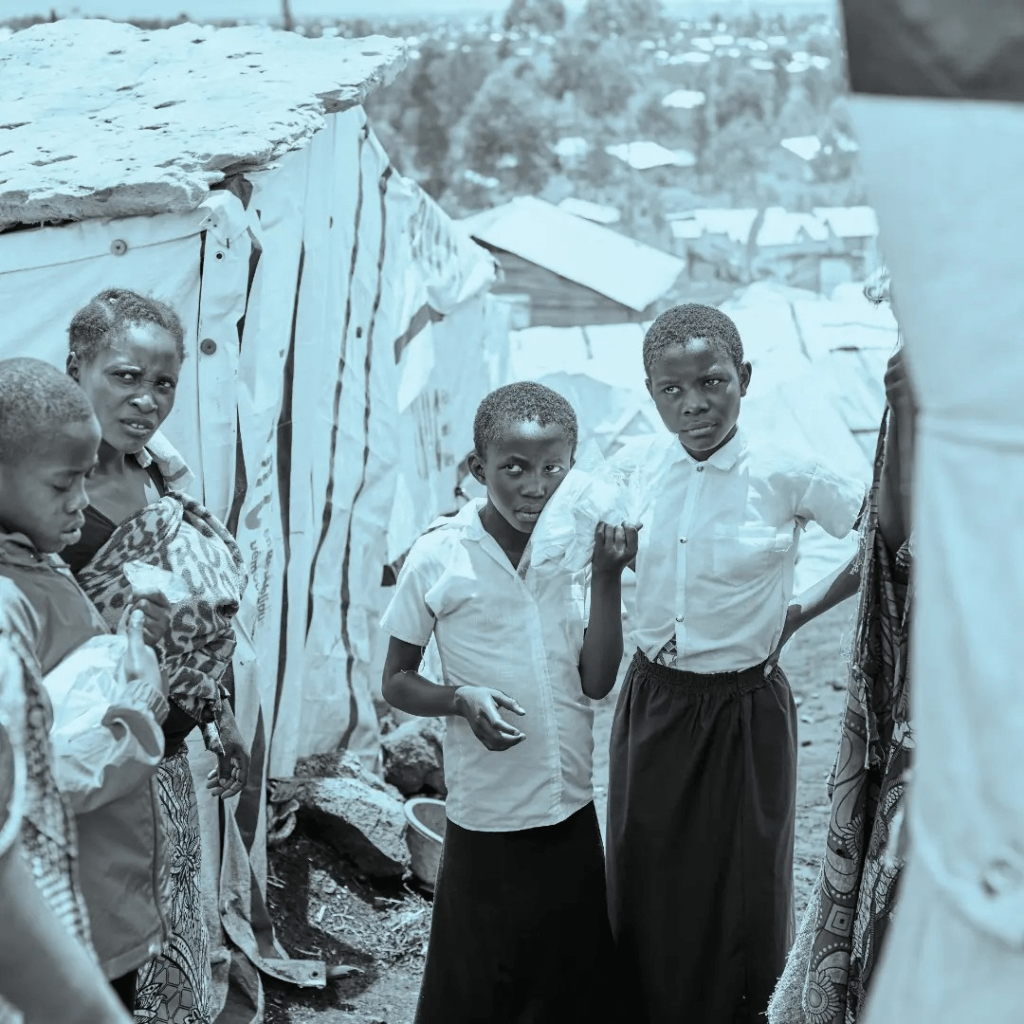
Last Thursday we stood on the porch of the schoolhouse, and my son and I were handed the new bright white shirts with their nice collars that give pride and a semblance of having a uniform to these students in this land where school children wear uniforms if they can afford them. The children were happy to get them. although there weren’t enough for everyone. I knew the sewing machines were at work to provide new shirts for all.

I was uncomfortable giving out the shirts, as if I had had a part in providing them. My son had been part of providing funding, but he was uncomfortable too ,he later said. It felt like a “photo opportunity” for us to be honored and photographed in this formal way. I made the most of it by being present for each child in the best way I could.

I believe that they thought we would want to be honored in this way. “Look at us and the good we are doing!” In truth, my son came to know the conditions, how the funding was benefitting others, and how to best move forward to help in the best way possible. As for me, I came to connect with and support my son, and my further purpose unfolded in Goma.

As we progressed down the line, I realized that these shirts were replacements, that the gray/brown shirts the children had on were the very same shirts. They had been worn daily for some time, were in a state of disrepair, and dirty.

Here is a photo of 2 students in their white shirts.

Our next move was to drive deeper into the camp, walk around, and visit some of the individual homes.

*Mothers and children make up the camp, aside from a very small number of older men. I do not know where the fathers are. I fear they are lost, that there are no men for the women and no male role models for the children. My guess is that they died attempting to defend their villages. I have many unanswered questions that I wish I had thought to ask. For this I apologize. I was so overwhelmed, and we moved so fast during this week, that many questions did not surface until I was on my way home.

Would you like to get blog posts sent directly to your email inbox? Subscribe below.