The Africa Posts
The sun was hot and high as we left the church, where the meal and the dancing and singing and laughter and connection took place. We (Bienve, his staff, and my son and I) turned right out of the structure and walked down a wide walkway, a continuation of the road we had driven on. We walked with purpose, and came to a place where the land dropped 6 or 8 feet, providing a wall below for a large group of young men and boys to kick a soccer ball against. 3 walls of humans beyond the drop-off formed a practice area. My son jumped down and gestured for the players to kick their best shots to him. They did. He served as goalie and missed the first 2 shots, then returned one, caught another, and on they played, shouting, cheering, laughing in the flow of this global pursuit of play, passion, physicality, and connection.

I realized during this time, approaching the soccer area and watching the action, that I had a protector. One of the staff members of Remember Youth for Change https://www.facebook.com/rememberyouthforchange had been assigned to (or assigned himself) to watch over me. I had met this young man on our visit to the office yesterday morning. I sensed he was one of those who had been abducted from his family to serve as a child soldier, but I don’t know this for a fact. He and one other man around his age (not much over 20) were always with us, sometimes driving. As Bienve and my son walked ahead, talking, this man was always by my side. I felt completely safe with him. I reached out for his hand or arm occasionally when I felt unsteady. He was always there, glad to help.
I referred to him later (to Bienve) as my bodyguard. I thanked Bienve for his presence. Thinking about this now, I believe that special concern and care for me arose from the text I had sent Bienve before we went to Democratic Republic of Congo, telling him of my husband’s wish that I not go to this country. Both of us were within arms length of protection, my son always with Bienve. I had not realized this at the time, had no idea that I was being watched over. I was not aware of this at the first camp, but I’m guessing he was there just outside the circle of children.
I wish I knew this young man’s name. I am not good with names in my own world, my own language. I know his name was told to me. (I had to ask several times to learn the names of Bienve’s wife and children.)
This young man, my protector in Goma, is the other person that I would like to help in some whay if the need ever arises. Payment for education, for a dowry? This is how one marries, I believe. Our driver in Rwanda told us he was saving for a dowry, to marry his chosen wife. Expenses are generally very small compared to here, but I truly have no knowledge of what this would mean. I would like this man to have blessings. I hope to talk to Bienve about it and to learn his name and express my willingness to help.
After 10 or 15 minutes, my son left the soccer field, we were brought to nearby toilets and wash station.
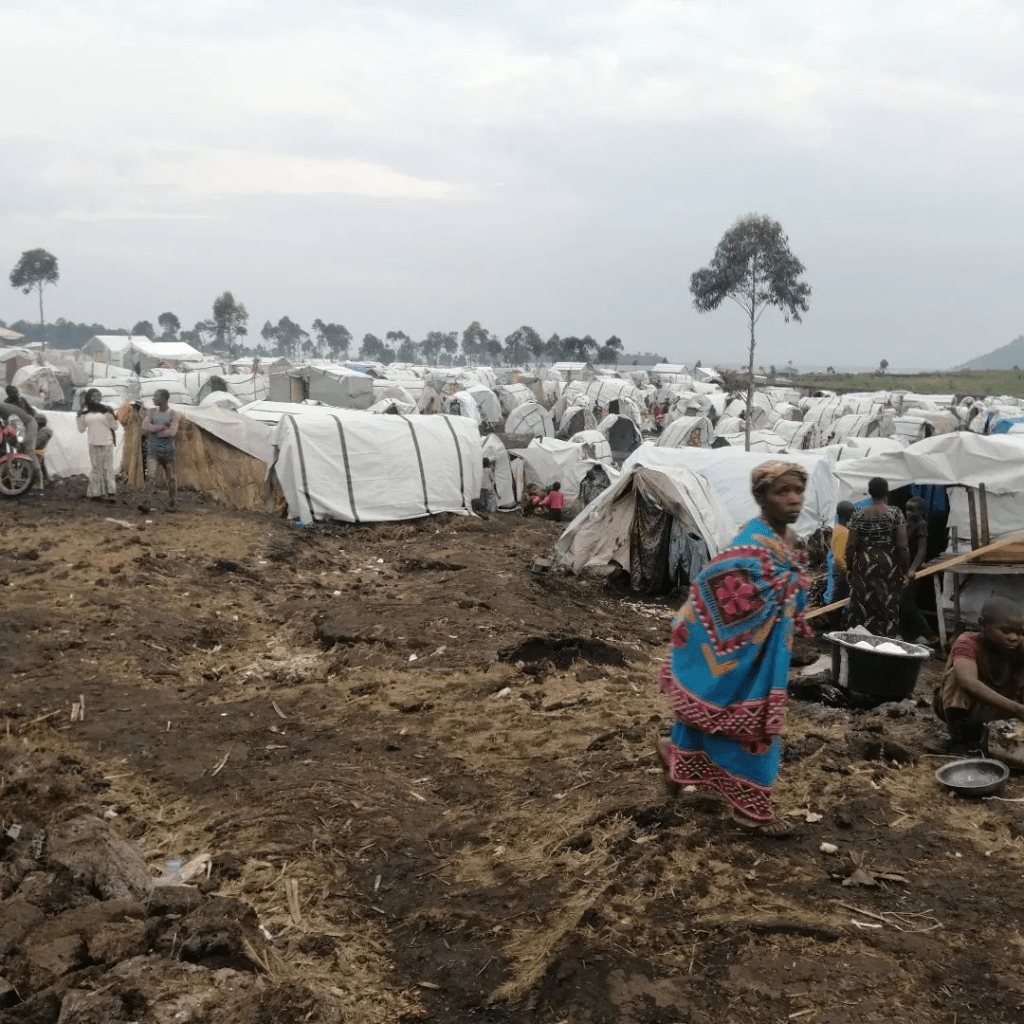
We walked back toward and past the church. Along our walks I smilled and greeted the people we passed with smiles and ‘bonjour.’ I’m not sure why, but the hardness and pain was gone from their faces. Did word travel about the meal, even though not everyone benefitted? About our serving the children, participating, connecting, the soccer play? Or perhaps they woke each day, newly grieving, and then the trauma subsided as the day passed and they engaged in their lives? I have no idea, but these people who had newly arrived at this massive camp looked into my eyes and smiled at me and said ‘bonjour’ in response to me. Not every one, but the majority.
Looking back, I felt I was witnessing healing at work, and I am so grateful for this.
We arrived a the humble small home of the “camp director,” where my son would give one of the new soccer balls to him. [This shelter was the same as all the others, and I have no idea what the role of the camp director is. One of the many questions I never thought to ask.]
I didn’t see the ball exchange hands, but I know it did. What I do remember is the humble prayer of gratitude that this man spoke in the open room. He gave thanks for the blessings of this day, the meal, the help, the connection, and for the blessing of us standing in his humble home on the floor of excrement. Bienve translated into English.
I remembered the kind and open face of this man, the camp director, from the events in the church. He ate with the church officials, he interacted with the people as a person of stature, and he served the food to the children.
The pastor also spoke with me in a friendly manner at one point, after he and I had eaten. I don’t recall the specific content of our conversation; it was in broken French and English. He served the people from behind the pulpit, but I did not see him engage personally. He may have. We all have our paths, but it struck me at the time that he and the other church officials ate on a bench behind the pulpit, out of sight. I know that I do not understand everything I saw. And there may be a value that I don’t understand in sustaining distance and formality.
As for me, I find close proximity and engagement to be the best path to help and healing.
Would you like to know more about Goma’s nonprofit Remember Youth for Change? https://www.facebook.com/rememberyouthforchange


 8 hummingbird way