Walking at the Bulango Camp

The Africa Posts

The sun was hot and high as we left the church, where the meal and the dancing and singing and laughter and connection took place. We (Bienve, his staff, and my son and I) turned right out of the structure and walked down a wide walkway, a continuation of the road we had driven on. We walked with purpose, and came to a place where the land dropped 6 or 8 feet, providing a wall below for a large group of young men and boys to kick a soccer ball against. 3 walls of humans beyond the drop-off formed a practice area. My son jumped down and gestured for the players to kick their best shots to him. They did. He served as goalie and missed the first 2 shots, then returned one, caught another, and on they played, shouting, cheering, laughing in the flow of this global pursuit of play, passion, physicality, and connection.

I realized during this time, approaching the soccer area and watching the action, that I had a protector. One of the staff members of Remember Youth for Change https://www.facebook.com/rememberyouthforchange had been assigned to (or assigned himself) to watch over me. I had met this young man on our visit to the office yesterday morning. I sensed he was one of those who had been abducted from his family to serve as a child soldier, but I don’t know this for a fact. He and one other man around his age (not much over 20) were always with us, sometimes driving. As Bienve and my son walked ahead, talking, this man was always by my side. I felt completely safe with him. I reached out for his hand or arm occasionally when I felt unsteady. He was always there, glad to help.

I referred to him later (to Bienve) as my bodyguard. I thanked Bienve for his presence. Thinking about this now, I believe that special concern and care for me arose from the text I had sent Bienve before we went to Democratic Republic of Congo, telling him of my husband’s wish that I not go to this country. Both of us were within arms length of protection, my son always with Bienve. I had not realized this at the time, had no idea that I was being watched over. I was not aware of this at the first camp, but I’m guessing he was there just outside the circle of children.

I wish I knew this young man’s name. I am not good with names in my own world, my own language. I know his name was told to me. (I had to ask several times to learn the names of Bienve’s wife and children.)

This young man, my protector in Goma, is the other person that I would like to help in some whay if the need ever arises. Payment for education, for a dowry? This is how one marries, I believe. Our driver in Rwanda told us he was saving for a dowry, to marry his chosen wife. Expenses are generally very small compared to here, but I truly have no knowledge of what this would mean. I would like this man to have blessings. I hope to talk to Bienve about it and to learn his name and express my willingness to help.

After 10 or 15 minutes, my son left the soccer field, we were brought to nearby toilets and wash station.

We walked back toward and past the church. Along our walks I smilled and greeted the people we passed with smiles and ‘bonjour.’ I’m not sure why, but the hardness and pain was gone from their faces. Did word travel about the meal, even though not everyone benefitted? About our serving the children, participating, connecting, the soccer play? Or perhaps they woke each day, newly grieving, and then the trauma subsided as the day passed and they engaged in their lives? I have no idea, but these people who had newly arrived at this massive camp looked into my eyes and smiled at me and said ‘bonjour’ in response to me. Not every one, but the majority.

Looking back, I felt I was witnessing healing at work, and I am so grateful for this.

We arrived a the humble small home of the “camp director,” where my son would give one of the new soccer balls to him. [This shelter was the same as all the others, and I have no idea what the role of the camp director is. One of the many questions I never thought to ask.]

I didn’t see the ball exchange hands, but I know it did. What I do remember is the humble prayer of gratitude that this man spoke in the open room. He gave thanks for the blessings of this day, the meal, the help, the connection, and for the blessing of us standing in his humble home on the floor of excrement. Bienve translated into English.

I remembered the kind and open face of this man, the camp director, from the events in the church. He ate with the church officials, he interacted with the people as a person of stature, and he served the food to the children.

The pastor also spoke with me in a friendly manner at one point, after he and I had eaten. I don’t recall the specific content of our conversation; it was in broken French and English. He served the people from behind the pulpit, but I did not see him engage personally. He may have. We all have our paths, but it struck me at the time that he and the other church officials ate on a bench behind the pulpit, out of sight. I know that I do not understand everything I saw. And there may be a value that I don’t understand in sustaining distance and formality.

As for me, I find close proximity and engagement to be the best path to help and healing.

Would you like to know more about Goma’s nonprofit Remember Youth for Change? https://www.facebook.com/rememberyouthforchange

After the Meal

The Africa Posts

After the meal at the Bulango Camp, we walked outside a bit. Initially there were trees here, but almost all of their slim trunks were used to shape the structures that serve as homes for each family.

Some of this time is a blur. Looking back, I realize how sleep deprived I was. I haven’t fully returned to balance as I write these words about 11 days after this meal I reported on yesterday. Right now it is early morning here, and it is 9 hours later in Democratic Republic of Congo – afternoon.

That afternoon, I had been in Africa for 7 days after a 23 hour segmented trip through the sky during which I slept 4 hours. Aside from my one day of hand washing clothes and visiting the Nile, I had full days every day, sometimes up before 4 am and/or up until midnight or later. I had fallen, injured my knee – which provided an extra night short of sleep due to monitoring my injury, changing my bandages and making sure I didn’t bleed on the linen. I got stitches the following day; my knee is still mildly inflamed. I somehow adjusted to the 8 or 9 hour time change (depending on the country) by force of our schedule. We had spent time in 2 areas of Uganda, slept in an airport due to cancelled flight, climbed a slippery hill in search of gorillas in Rwanda, crossed the border by land into DRC, and spent 2 very full days in Goma with Bienve.

I am quite aware, due to my condition since my return, of my age. Did I say I am 68? I am in good form for my age. I have eaten concsiously since my 20s, I lived on a fairly steep hill for most of the past 25 years, I did a lot of bicycling for 10 of the past 15 years, I stretch daily and walk often, though I am slowing down the past 2 winters. All of this allowed me to take this trip, and I know I will return to well-being soon.

For peace of mind, I will visit a specialist in tropical infections soon, although I expect a clean bill of health. Something passed through my body in the first few days home, but I am feeling stronger daily.

The impact of this journey on my soul is immeasurable. For all of it I am grateful. I carry much more within my soul than I did when I left. The impact of each soul I connected with, each child’s and woman’s face I looked into, smiles shared, hands touched, steps walked beside, meals taken with – has left its mark. And I also hold a part of the loss in my heart, the loss that came before that which now shows in the faces I looked into.

And I hold the knowledge of each helping person who saw the need and created solutions. I hold within me the knowledge and experience of those who wielded help and showed me these comparatively small areas of our planet with people in need, as a result of loss and trauma. They showed me how they took personal action to provide others’ healing and ability to walk forward into their uncertain future.

I stress “small areas of our planet” because I know that loss and pain and trauma exist in many other places as well. Places we hear about on the news. Places we are not aware of. Some are in our communities. Some are next door to us. I know that loving others are nearby to help. The loving others who help those in need is an important part of my story, though I have not written about it fully. I have only a miniscule knowledge of it. I know a small handful of their faces, shown to me on this journey – honored, appreciated and loved by me.

I hope to extend myself in ways that will unfold as I walk forward. My way is a smaller and more personal way than the way of these who create organizations and attract other helpers and step forward powerfully and bravely in love and support of their fellow humans. Their names are Beka (who I have yet to write about), Kuol, Bienve, and there are many others – those with vision, and those who spend their time and resources in support of the vision of these leaders.

Either way, it matters whether or not we choose to help fellow humans within our reach.

I have witnessed and touched a great deal. Were it not for the blessing of being able to share my journey through this writing, I would not be able to process it. But I am – day by day – in gratitude and love and grateful absorption, release and transformation. Thank you for reading my words. For caring, for being willing to hold this knowledge I share.

I meant for this post to be about the walk after the meal. But this day and this meal is a huge aspect of what I am carrying and holding now. And so it turns out that I have shared a bit more about this more personal aspect of what I saw and carry within “After the Meal.”

Would you like to know more about Goma’s nonprofit Remember Youth for Change? https://www.facebook.com/rememberyouthforchange

Holding back tears

The Africa Posts

I apologize for this long post. I cannot see how to break it up into pieces.

When I was on my drive to the airport, 8 days before our visit to Goma, my son texted me that Bienve had asked him if we wanted to provide a meal for 100 children at a refugee camp, for $300. I expressed a willingness to spend the money but questioned whether this was the best use of funds. My son said to trust our host regarding that question. We agreed on the plan for a large meal, and today was the day.

This was to be our last full day in Goma. The following day we would return to Rwanda for an evening flight.

It had been decided to do the cooking in a more inexpensive way, and to keep the ingredients simple so that 400 children could attend rather than 100.

It turned out to be a church event. Some women had been cooking for rice and beans and cabbage and beef for hours and hours behind the church.

On the way to Bulango Camp for Displaced Persons, which was outside of Goma a few kilometers, we were warned by Bienve that we would probably hear artillery. It was uncertain whether it would be safe for us to walk around the camp. We did hear what sounded like rockets being fired nearby 3 times during the day. I did not focus on them and was not afraid. I had decided long ago to trust this journey I was on.

When we arrived and drove through the camp, I saw faces of hardness and great suffering. I understood later that this was a much larger camp than the one we had visited the day before, and that the inhabitants had arrived very recently. I smiled as I do, but …there was no room for smiles here. Nothing penetrated, and I had to hold back tears several times at the enormity of the pain and trauma I saw in face after face.

When we arrived at the church – a larger structure wrapped in the white plastic, we got out of the car and headed in. My son turned back from the entrance and saw my face. He stopped and said “You can’t cry.” I knew he was right, although I couldn’t put words to why at the time. I realized later that it would have been self-serving, this release for me of the horror I felt, as the people we were serving presented in the best way possible. It would have appeared pitying, and maybe it was. Pity is not something I am aware of feeling or something I align with. But I have no words for the version of sorrow I was experiencing. There was a deep threat to the wellbeing of the people I saw here.

This next few minutes was my most difficult time in Africa and it is with me still. Tears show up sometimes, and I trace them back to this point in time.

I assured my son that I would find a positive focus and would not cry.

We entered this place with 400 children sitting on benches. There were maybe 20 adults who would also eat this meal, including the 2 or 3 women who were preparing food in a tiny enclosure behind the structure. There were the organizers, (Beinve, support staff from Remember Youth for Change who rode in the van with us), a young male drummer, some older male church officials, and my son and I.

When I look back I recognize the blessing it was to have been at this event on this day in this place. It seems unreal, especially now that I am home in my comfortable surroundings. But I was there for some reason. Perhaps to teach me; perhaps to enable me to tell this story of my experience.

After peeking at the cooking process, I just stood there near the front of the church. My son told me to find a place to sit; I needed direction on this day. I went to a bench behind 2 rows of women. I don’t remember where my son sat, or if he did sit.

I focused on the place where the joy lies for me – children. There were a few little ones who were sitting near their mothers, and who I was able to connect with. I offered my smile and they came close to me and we talked a bit.

Bienve became my hero on this day. He performed the miracle of alchemy. He turned pain and suffering into joy and laughter before my eyes.

There were some announcements and introductions. Bienve said early on that the adults would eat first, as the children need the adults to be strong for them. (There was a lot of waiting for these children, who sat patiently for hours.)

After all the talk and a blessing by the pastor, the magic began. The women on the benches in front of me, and an equal number of men from somewhere (12 total) got up to dance a tribal dance in 2 rows in front of the pulpit, facing the congregation of chidren and others. I was on the side benches. There was some sort of portable sound system that provided music.

The women were dressed in their best – there were layers of color and fabric tied artfully and the clothes fit them beautifully. They were stunning. The women wore fabric headcoverings.

When sitting behind them I had noticed a few small holes in fabric and frayed zippers, but everyone presented beautifully as they stood and danced before us. Their presence in the dance was magical and powerful and healing for all. They danced for maybe 10 minutes to a song that everyone knew. The smallest children knew the words. They danced in 2 lines and at times the men and women faced each other, traveled apart, and rejoined. Hips, torsos and arms moved like fluid. I wanted it to go on forever. I wanted to know the song, learn the song, but it was elusive. When I asked about it on the way home in my broken French, I was unable to explain which song I was asking about. There was much music and many songs sung on that day. It was an experience not to be captured and brought home, but only to live in my heart and soul. I reached out to touch the arm of the closest dancer, 2 benches in front of me and said “Tres belle” – very beautiful – she thanked me and smiled.

Next 6 children danced in a competition – 3 girls and 3 boys. Much cheering followed.

There were more dances and songs. by the children.

Then there was a balloon-blowing contest. 3 boys were selected and each was handed a long wavy bright balloon. The first to fill and break his balloon was the winner. The ballons started to be blown up, and the crowd started cheering. One burst. The second burst, and all 3 were sent back to their seats. Then 3 girls repeated the exercise.

Now it was time for another 3 boys, and this time my son was invited to participate. He stepped up with a big smile and was handed a blue balloon. There was increased excitement and chatter and laughter in the room. His 2 competitors came up to his waist and chest. He filled his balloon with air first, but took some time to break it, so that at least the 2nd place person had a full balloon. This is where we first showed ourselves to the group, and it was very positive, laughter and smiles all around.

The line between our world and theirs has been erased with laughter and delight all around.

After this, it was time for a coloring event that many of the children participated in.

After each event, we witnessed a simple, sweet and rythmic expression of gratitude to all the dancers, all the participants. It took less than 10 seconds. As the day went on, we joined in:

-3 claps, then hands on one cheek, (in a goodnight or going to sleep position, leaning the head on the hands), along with the sound “mmmm-mm,”

-3 claps, then hands on the other cheek, “mmmm-mm,”

-3 claps, then 10 fingertips on the lips and kiss the air audibly “Mwa!” as the fingers are opened outward (similar to the 5-fingertip praise for a fine Italian meal).

The food was to be brought forth soon, and my son suggested I might want to get up and walk around, so I did. People knew I provided the meal. Or that we did. I walked up and down the 2 aisles between the benches where the children sat patiently. Connection and warmth, smiles and laughter flowed. Touching of hands, and “bonjour.”

Toward the end of that walk, just before the meal, Bienve led everyone in a song that they all knew and soon I joined in. The translation is “God is good to me. God is good to me. He blesses me. He helps me.” This song went on for a very long time and was animated with hand movements. It was joyful to sing.

My son and the staff from Remember Youth for Change were the food servers. My son asked me if I would like to serve. I hesitated and then chose not to, for which I am glad. He + Bienve’s wife, Clariss, served the rice, and it was a painful endeavor for his 36 year old athletic arms after just a short time. This was the hardest task, as every plate recieved 2 full scoops of rice. There were 5 pots of rice, a pot of beans, a pot of cabbage, and about 1/3 of a pot of beef peices. The pots were about 2+1/2 ft across.

The church officials and I (and perhaps some of the other adults) were served. After getting my plate, I looked around helplessly until someone brought me a spoon. Looking back I am embarrassed by this. Almost everyone, including my son and Bienve, who ate after the children, ate with their fingers. Only the church officials and I needed this help.

I am so proud of the man my son is, and the awareness he carries.

I went to sit with the church officials behind the altar, then knew that was wrong. I was not part of the church – I also had some questions about this event being in the church. I moved to a bench near the entrance and ate by myself.

There was a washing station with soap and poured clean water with a bowl to catch. Everyone used it before eating.

After eating, I put my emptly paper plate in a pile of used plates and went to sit down. I was overwhelmed by everying around me, and oblivious of the fact that all the fed adults (except the church officials) were serving the children where they sat. My son left his post and asked me if I wanted to help serve the children. I did! We took paper plates, waited in line to fill them, then brought them to each child in the rows of children who had washed their hands.

After eating, people slowly left the church.

Many of the children did not have parents with them. I noticed, as I had seen before, that quite small children look after their younger siblings. There were no infants strapped to 4 year old backs today, but this is very common in all 3 countries we visited. I did notice that when the older sibling was not holding on, the younger sibling was sure to – they never let go of their brother or sister’s waistband.

During this event, I was aware that there were many many children outside who were not fed. This did not sit well with me, and I’m sure I was not alone. The event had captured a lot of attention. While I sat and ate, several faces at nearby holes in the plastic sheathing asked me for money and said things I didn’t understand, all respectfully and with smiles. Later on, I noticed a row of about 5 children sitting at a new opening in the plastic. After the meal, I asked my son why they couldn’t be fed and he said it would create a problem. Of course. I realized that a relaxation of the boundaries in place would interest many …and possibly cause more damage to the structure. The small amount of leftover food was brought outside on individual paper plates when people left. I have no idea of it’s destination – friends and neighbors? Elders or sick?

There was no tussle or snatching of the food by the crowd outside.

Soon we left the church to walk around the camp briefly.

Would you like to know more about Goma’s nonprofit Remember Youth for Change? https://www.facebook.com/rememberyouthforchange
Authentic dinner with the Family …and Sleep

The Africa Posts

After our visit to the first Camp for Displaced Persons, we decided that we would eat together at an authentic Congalese restaurant with Bienve’s family. On our travels we did out best to support restaurants that provided local cuizine and allowed us a more full experience of wherever we were. After a short break at our hotel, Bienve returned for us, having already brought his family to the restaurant. That day we had been attempting to secure local currency, but our debit cards were not functioning – possibly due to US economic sanctions against DRC. Bienve covered us until he returned us to Rwanda and we were able to function again financially.

While my son was at an ATM, Bienve shared with me that he had adopted 4 children before he married Clariss …and then they had 3 biological children. He said this was common in Goma, that people would bring others into their families. At dinner, we were to meet the older adopted girls and the 3 younger ones.

Clariss and one of the older daughters turned out to have been people we had met earlier that day. They were staff members at the Remember Youth for Change office https://www.facebook.com/rememberyouthforchange They helped to cordinate and organize the growing sewing industry. The oldest girl (around 18-20) was Sarif. I liked her a great deal. The 2nd one (15) was Alexandrine. The little ones were Elena(5), Elia(3), and Ilio the little boy(2). the talk was not plentiful, but everyone was a delight, and Bienve took photos after the meal. It was a little awkward, but the next day at the Bulango Camp for Displaced Persons, I was happy to have met them and to know their names and faces. I felt that I had allies and connection to steady me in our common mission.

This was our first authentic meal in DRC, but we had experienced similar cuisine in Uganda. I’m not sure whether the quality was superior this evening, or whether I was becomming accustomed to the offerings, but the food was excellent. There were various types of potatoes, yams, squash, and cassava, white and brown rice, 2 kinds of greens – one I had not heard of before. There were various meats – goat, beef, chicken, and something called black pork – a superior pig according to Bienve. There was also a delicious peanut sauce that one could eat with potatoes, squash, rice, yams or cassava. We had experienced this peanut sauce at a home-cooked meal and in a couple of restaurants. [When I was in Uganda I had tried chicken gizzard (not bad), a strange brown congealed bread (not my favorite), and cassava (fibrous and dry; it grew on me a little by the time I left Africa). Fruit juices were also plentiful. The coffee was spiced with ginger in both Uganda and DRC, which definitely grew on me.

Fortunately, my grandson, who was the first family member to go to Africa with my son, had warned me to “always have toilet paper”. He said “sometimes a toilet is just a hole in the ground.” This was the case in, or rather just outside, this restaurant. It was a nicer hole surrounded by tile in a small tile cubicle. I appreciated the hand-washing station outside, and one inside the restaurant.

Exhaustion made it easy to sleep as soon as my head hit the pillow, and I must have finally adjusted to the time zone – 8 hours difference.

I did not feel disctubed that night by our visit during the day at the refugee camp, partly because I was exhausted. I had been up since 3:30 am, driven across the border, seen and experienced a great deal that day, met a lot of people, and was exposed to personal upheaval like I hadn’t seen before.

Looking back, I witnessed some level of emotional stability in the people I encountered – thanks to local people like Bienve and the staff at Remember Youth for Change, as well as the local schooteachers. These people that had been displaced had a safety net here in Goma, and they seemed to be adjusting to their surroundings. They had people around them, and they had support. What I saw in their eyes and hearts was hardship, uncertainty, and a new, unchosen, way of life.

I also saw community. I saw support and possibility and the amazing resourcefulness of humans.

I hope this doesn’t sound callous. I know my privelege and I understsood the heartbreak that these mothers, especially, had endured – being displaced, without their mates and having almost nothing familiar around them, living with the uncertainty of their future, their children’s future, and of gunfire in the distance.

Despite all of that, I felt I that the refugees were finding their place, finding their footing in this new reality they navigated.

The next day at the Bulango Camp for displaced persons felt very different to me.

Would you like to get blog posts sent directly to your email inbox? Subscribe below.

Potato Field, Allies, and “Thunder”

The Africa Posts

We returned to the van and drove on the central road to park by a large potato field on a hill. Near the van, more land was being tilled by some older boys of the refugee camp. It was clearly very hard going.

This camp had been in existance at least long enough to grow a crop of potatoes. Bienve had told us that an area of potato plants (out of sight, over the hill) had been dug up and taken recently. He said he did not blame the perpetrators; he knew that hunger drove them. However, it was a loss for the community.

The caring presence of Bienve can be seen here, in a video of displaced persons from one of the camps in Goma, working in the potato fields, creating agribusiness.

Beinve and my son walked up the hill to see the gardens beyond, and I stood by the working boys. The photographer who had been traveling with us leaned on the van, along with 2 men who had been child soldiers (1 was the driver). There was a steady trickle of children walking along the road and I wondered where they were going to and from. I smiled and said “bonjour,” and I soon had another group surrounding me. I felt a little closed in, and this group felt different than the walking group from earlier. I think it was my difference, my skin color, that attracted them for the most part. I heard the word Mzungu (meaning white person) a few times. There were no very young children, and it seemed like an elementary school crowd. I wonder now, whether there was some sort of informal schooling set up as well as the one we visited this morning. These children had no uniform, but I sensed they had purpose. Several said “money,” which I ignored, as I had been advised.

I reached out in my mind for some French words that I could say and after some faltering attempts I arrived at the phrase “Tout les enfants sont bon,” which means “All children are good.” The children agreed with n heads nodding. There was warmth and smiles. It may have been that I was a bit tired or depleted; it may have been that these children had less need. I learned that the level of need is much greater if one is a very recent refugee.

After maybe 10 minutes, a man came along to shoo away the children. I thought it was the photographer; he had a similar build. I didn’t like the fact that he sent them off unceremoniously, but I was in a mode of acceptance about choices made around me while I was in another culture in another part of the world.

I stepped to the other side of the road to talk with the man, who seemed to have something to say. There was some back and forth in English and French and after a few minutes he started asking me for money. I said no; I said I don’t have any, but why would he believe that? (My son was handling funds; the exchange rates were a bit confusing for me.) He persisted, and I glanced over to the van where my 3 friends were still leaning. I realized this wasn’t the photographer I was talking to. I left him and walked over to join them, leaning on the van until our next move.

I felt very comfortable with these men from Remember Youth for Change. https://www.facebook.com/rememberyouthforchange

The photographer was clearly a fan of mine. I had noticed him photographing me at various times. I had taken to smiling and pointing to my son as the main event – which he definitely was. I felt he (the photographer) was a person who saw value in my warmth, which I tend to offer easily. My son is the one, however, who cares enough to create change and to make sure the corporate funds he controls are used well – and expends a great deal of energy understanding what is needed in various parts of the world.

The 2 men who had experienced being child soldiers also have my heart, especially the one who was the driver. I will return to him another time.

At one point during this visit I heard thunder. I believe it was when we were standing by the potato field. I did not find out more until we returned to the US; at the time, it was kept from me that this sound was actually artillery fire. I never felt unsafe when I was in Goma or the surrounding area, but later it was explained to me that all was not as I experienced. I know no more about this and it is not my area of interest. Except that the occupants of the refugee camp have had to contend with this instability along with all of their loss.

Would you like to know more about Goma’s nonprofit Remember Youth for Change? https://www.facebook.com/rememberyouthforchange

Visiting homes and walking in the refugee camp

The Africa Posts

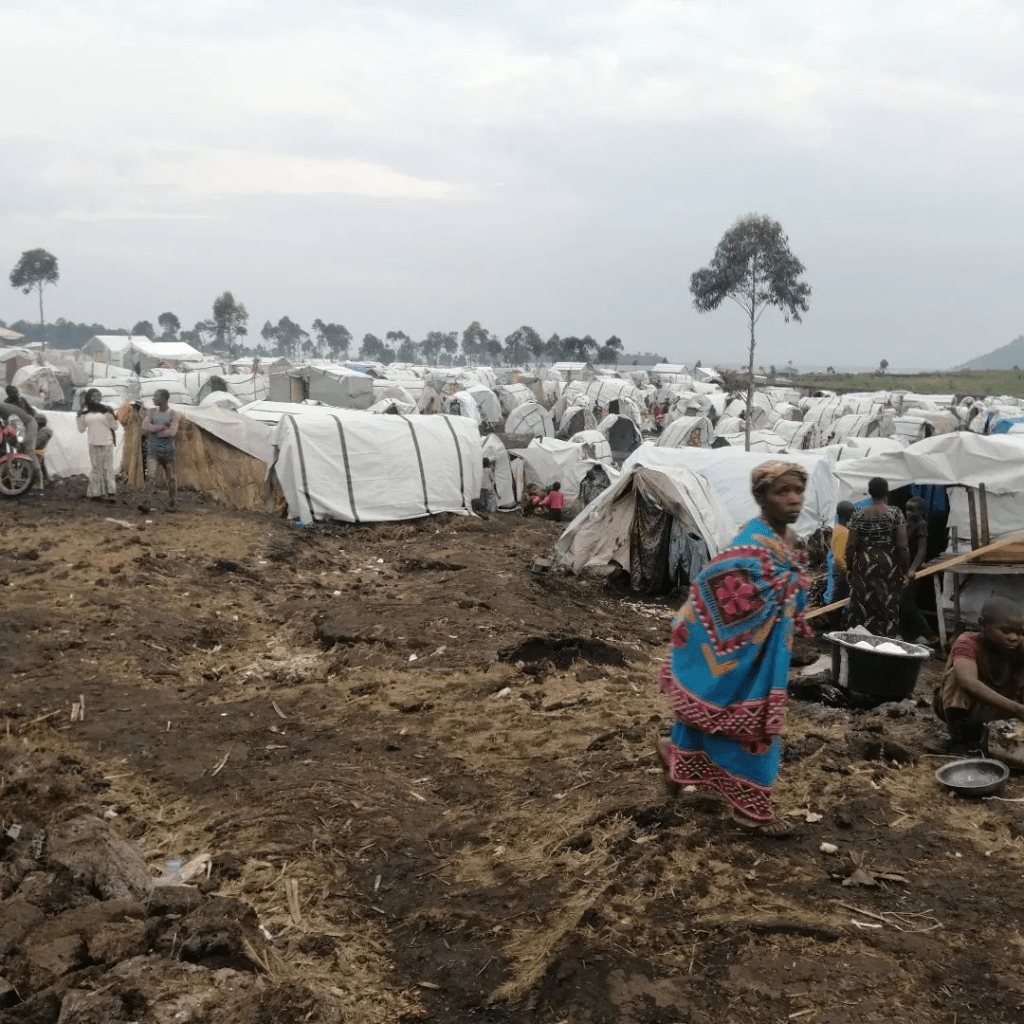
We drove deep into the camp, perhaps another half mile, parked, got out, and started to walk around the “homes.”

“UNHCR, the UN Refugee Agency, provides emergency protection and assistance to keep them safe, including shelter, access to clean water, food, medical care and help to reunite families.” Based on my limited experience, the refugees you will see in the photos of this website have had showers, new clothing and more food than the people I met. https://www.unrefugees.org/refugee-facts/?gad_source=1&gclid=Cj0KCQiAoeGuBhCBARIsAGfKY7xSF1MSr_Vv3dR7Hap0A6stsKZcbOWj-jw958SWNJdWD0zMDGeL5H8aAnmwEALw_wcB&gclsrc=aw.ds

I am glad to hear about the clean water, food and medical care – and the reuniting of families. I didn’t see any of that, although I did use the sanitary facilities, visited some individual shelters and one larger structure designated as a church.

The tiny homes, about 5′ X 5′, were the main substance of the camp. We entered 3 families’ homes on this day. Although the website shows homes with thatched roofs, these homes were all wrapped in white plastic (like Tyvek) – sides and ceiling – with a door cut out, and the same plastic covered the home. There were white plastic room dividers inside, separating the sleeping area, with one or two mats, from the empty rest of the shelter. That’s it. There were no clothes in evidence aside from what the people are wearing. In one home I saw a small bowl of stems with leaves, but most of these shelters were completely empty aside from the sleeping mats in the sleeping room, 1-2″ high. Some of these mats had frames of some sort, and some seemed to be a pile of fabric.

We walked through the maze of these small cube homes. They stretched on and on. The ground in much of Goma, and in this refugee camp, was made of lava from a volcanic eruption in May 2021. The rocks and dust from the residue of that eruption was not easy to walk on. As an older person, I had to watch every step. The ground was hard and uneven; I could perceive the flow from 3 years ago.

Bienve, director of Remember Youth For Change https://www.facebook.com/rememberyouthforchange guided us left and right; he had secured permission for us to enter 3 homes. The first 2 were simple 2 room units and one had the bowl of stems + leaves I mentioned. The third home was the same size as all the others, but had been divided into 3 rooms. The residents here were a very pregnant very slim woman and her 4 or 5 small children. It was noted that there would soon be an additional resident. I tried to talk to the woman, but she was not responsive. (My French is not great and I don’t know her familiarity with French.) She seemed overwhelmed. I slipped my simple wooden beaded bracelet from my left arm onto her right one and there was an instant of silence. It wasn’t something I thought out, just an “instinctual” act, although I have thought of it many times since. I hope there were trades she could make using my simple gift. Perhaps this is unrealistic. I have no idea of the culture of the camp. What has value (each bead?).
After the visits, we continued on. At one point my son, a soccer player, came across a few boys with an almost unrecognizable brown soccer ball. He gestured to engage with them/challenge them, and the group of 4 or 5 moved in an animated way across the rough lava ground for several minutes.

As for me, I have always been a lover of children. And there was no shortage of children – everywhere! I offered my smile. And the children responded. They recognized my genuine smile and allowed themselves to be drawn to me. Smiles, laughter, openheartedness. There was talk – mostly me saying “Je ne comprends pas,” (I don’t understand) but sometimes I would come up with a word “hand,” “foot,” “friend,” “amour.” I wish I had thought of “song.” I would have loved a song, just from the children. I did say my name occasionally and asked theirs which I didn’t retain at all. After a few more minutes of walking along, I had a large group of children around me touching me, 2-3 holding each hand/arm. For me, this was a delight beyond all others. They read my heart, returned my smile, and I laughed with them and was even more careful with my steps on the uneven ground.

My son and Bienve were maybe 30 ft ahead and they stopped every few minutes. I would do my best to catch up. A couple times I lost sight of them, but then I saw a flash of my son’s shirt down the row between some shelters, and turned that way.

Most of the women we passed smiled at me now, where there faces had been empty when we drove into the camp. I became more comfortable and said a timid and warm “Bonjour” to each woman we passed.

This was the highest joy of my experience in Africa. Children surrounding me with open hearts. The open warm smiles of mothers in loss. A meeting and connection of humanity, of laughter and smiles – and simple joy and fullness for me.

These are the connections one can make: a soccer challenge, smiles, the gift of a bracelet. (It was perhaps a help that we wouldn’t have been able to communicate with language.) These gifts come from an openness on both sides to engage as humans. There is giving and receiving on both sides and true connection results, even if only for an instant.

When I say this was “the trip of a lifetime,” – it is these moments I return to.

My son had said he came on the journey this year with a specific hope to reconnect to his inspiration. The nonprofit work for him had lost something. I felt it was the human connection. He was very involved in the assessment of the funded work, the local organization and local leaders who had secured help and funding, as well as discussion future plans. On this day – having engaged with a soccer ball and several youths, he decided that he would purchase 2 soccer balls that evening and bring them to our outing the next day at the larger refugee camp outside of Goma. (His first connection to Africa was through bringing soccer to a remote village in Uganda.)

Just before we left, Bienve brought a woman over to the vehicle who, he said, would give away some of my gifts, more to the pregnant mother, and some to others. I had a pair of glasses (I had more at home) some scarves, a turquiose stone, some earrings, a feather, some hair clips, I can’t recall what else – and he allowed me to give them to her and save the rest for tomorrow’s refugee camp.

Deep thanks to my friend who said, when she heard I was going to Africa, “What gifts will you bring?”

One last thought. Although I did not feel a personal connection with the pregnant woman, I have thought of her often. I hope that the child was planted in her womb by her mate, who she is without, at least for now. Perhaps forever.

I know there will be additional burden with the coming of this child. I hope there is some blessing for her as well.

My son says there is nothing I can do for her specifically, that I can donate to Remember Youth for Change https://www.facebook.com/rememberyouthforchange or to his (my son’s) organization that helps so many.

But I am more of a one to one person. I keep thinking of a personal sponsoring for this woman and for one other person I met in Congo.

My son would say that I would risk unwise use of any funds provided, and I know this is true.

There is more to tell of this visit.

Would you like to get blog posts sent directly to your email inbox? Subscribe below.

First Refugee Camp – School Visit

The Africa Posts

Our host, Bienve, and staff from the nonprofit organization Remember Youth for Change https://www.facebook.com/rememberyouthforchange drove us to the refugee camp.
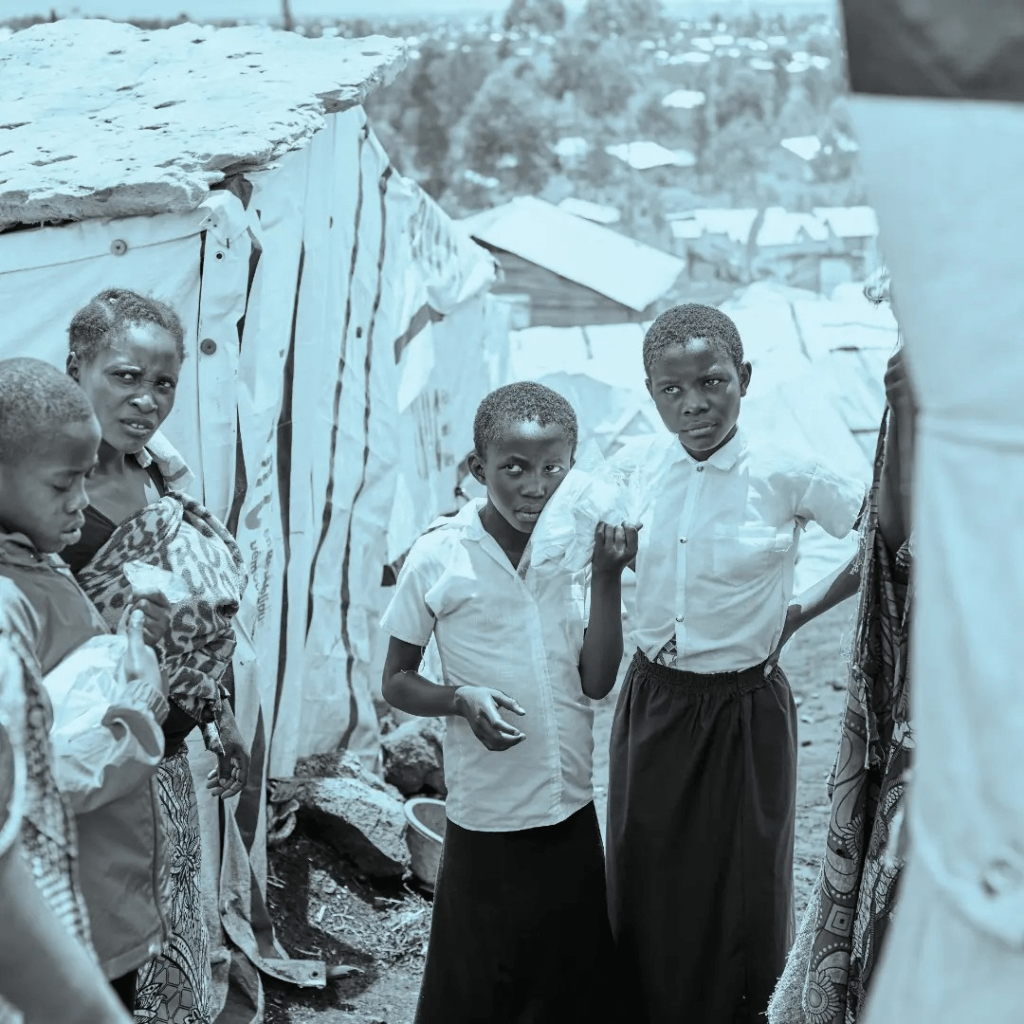
Our first stop was at the school. This school is a community school, and the staff found a way to expand and meet the needs of the displaced children as well as those who already attended. The teachers teach the local children in the mornings and then teach displaced children from the camp in the afternoons.

The afternoon class is large from the camp, and the students only go to school if their parents approve their attendance. There are many many children in the camp – and about 30 lined up for new shirts. There may be more who attend. I’m not sure how large the entire afternoon class is, but we only had about 20 shirts to hand out.

Most displaced parents do not want their children to attend school. From what I know, formal education is not part of a tribal lifestyle.

I’m glad for the rule about school being a parental decision; when we schooled the native children in our country, the parents did not get to approve the decision. After forcing Native Americans from their tribal lands, our forefathers then took their children from the broken tribes – and “schooled” them (often in boarding schools) to conform to European/American religion and culture. The children were not allowed to use their given names or speak their native languages. [Read The Education of Little Tree if you want to know more about this.

Here of course, the story is different. An external military unit forced these people from their tribal lands, and transformed them into refugees. The schooling is a generosity, from what I can tell. The people still sing their songs, keep their names, sustain their tribal identities, and go home to their mothers* and siblings.

I know that Bienve respects the tribal ways.

Regardless of intention, the tribal ways and the tribal closeness to and alliance with Mother Earth has been shattered, along with the connection to ancestors.

And these children are going to have to navigate the dominant culture in DRC (Congo).

Last Thursday we stood on the porch of the schoolhouse, and my son and I were handed the new bright white shirts with their nice collars that give pride and a semblance of having a uniform to these students in this land where school children wear uniforms if they can afford them. The children were happy to get them. although there weren’t enough for everyone. I knew the sewing machines were at work to provide new shirts for all.

I was uncomfortable giving out the shirts, as if I had had a part in providing them. My son had been part of providing funding, but he was uncomfortable too ,he later said. It felt like a “photo opportunity” for us to be honored and photographed in this formal way. I made the most of it by being present for each child in the best way I could.

I believe that they thought we would want to be honored in this way. “Look at us and the good we are doing!” In truth, my son came to know the conditions, how the funding was benefitting others, and how to best move forward to help in the best way possible. As for me, I came to connect with and support my son, and my further purpose unfolded in Goma.

As we progressed down the line, I realized that these shirts were replacements, that the gray/brown shirts the children had on were the very same shirts. They had been worn daily for some time, were in a state of disrepair, and dirty.

Here is a photo of 2 students in their white shirts.

Our next move was to drive deeper into the camp, walk around, and visit some of the individual homes.

*Mothers and children make up the camp, aside from a very small number of older men. I do not know where the fathers are. I fear they are lost, that there are no men for the women and no male role models for the children. My guess is that they died attempting to defend their villages. I have many unanswered questions that I wish I had thought to ask. For this I apologize. I was so overwhelmed, and we moved so fast during this week, that many questions did not surface until I was on my way home.

Would you like to get blog posts sent directly to your email inbox? Subscribe below.

Personally

I wondered how I would cope with this journey being over. But it’s not over. My heart and my soul have been deeply impacted and there is more to do. Telling the story of my journey is part of it. Right now I’m not sure how to even be myself.

I walked into my home Monday morning and saw my husband and the tears started. They live close to the surface now – for which I am grateful.

Tears should always be close to the surface, I think. So that we can release the experiences and challenges we no longer need to hold on to. Mine were shut off for many many years, and I had been holding onto much.

There has been a slow resurfacing more recently, and now, after this jounrey, I feel I live with them (tears) right here with me, ready to flow if need be. It feels like the right way to live.

I would also like to live with laughter close to the surface. Perhaps other things as well.

As well as a the desire to tell about what I’ve seen and experienced, I would like to learn how to walk with a load on my head, as so many of the people in Africa do. I saw it over and over and I’ve always loved that image, and the simplicity of carrying a load in that way. We shall see whether I have the balance and strength to do it. Or whether one must learn this ability at a younger age. Or whether I will even sustain this intention. It’s going to have to wait for warmer weather!

I am physically challenged from the journey. It was all I could do to drive home 3+1/2 hours yesterday on the morning after my 3rd plane landed (Sunday at 2pm). I am listless, short-tempered at times, hot and cold, my feet are falling asleep often, I’m sleeping an awful lot, a small cut is not healing, I’m not eating much, and have to make myself drink. (My son was in the hospital for dehydration last night. I feel for him. He had to put off an important job interview from Monday until Tuesday, and then realized he could not think. Thank God he was able to recognize that he needed help.) I have not lifted a finger in the past 3 days to cook anything. After looking at my calendar about 8 times, I prepared to leave for an acupuncture appointment Tuesday, then realized it’s not until Wednesday when I saw the date on my check. I’m nervous about taking a shower, and I clearly need one (I did take one Sunday night).

I am very fortunate to have a tolerant and supportive husband. He just put on some lovely music tonight that has me teary, so the shower will have to wait.

I know people are waiting to know more about my journey, but there are many aspects to what has occurred. I will continue with my trip to the first refugee camp tomorrow.

Would you like to get blog posts sent directly to your email inbox? Subscribe below.

In Goma

The Africa Posts

I write from home now, I am not the same self that left …and I will talk about that another time.

I will continue to label these writings “The Africa Posts”

I have not shared everything about Uganda yet, but I must report on Goma now. I do not want to endanger the missions there, and I need permission to tell some things, but there is much I can share, and it is best I feel for me to share events as they happened, in sequence.

When I said I love Congo and her people, it’s because so many of the people of Congo are actually in Goma. I did not travel more than a few miles from there, but Goma is a place where many people seek refuge.

I have recieved permission to use the name of our host, Bienvenu Kamwendo and provide a link to his organization, Remember Youth for Change. https://www.facebook.com/rememberyouthforchange

When we crossed the border from Rwanda, Bienve brought my son and I to the hotel he reserved for us. We paid, left our luggage, had a quick breakfast, and went on to visit his office near the church. There we were formally introduced to the staff of Remember Youth for Change. https://www.facebook.com/rememberyouthforchange, a small but impactful group with several missions at work. Bienve is the founder. We met local members/employees of the organization (one is his wife and one his daughter we later learned), and several former child soldiers.

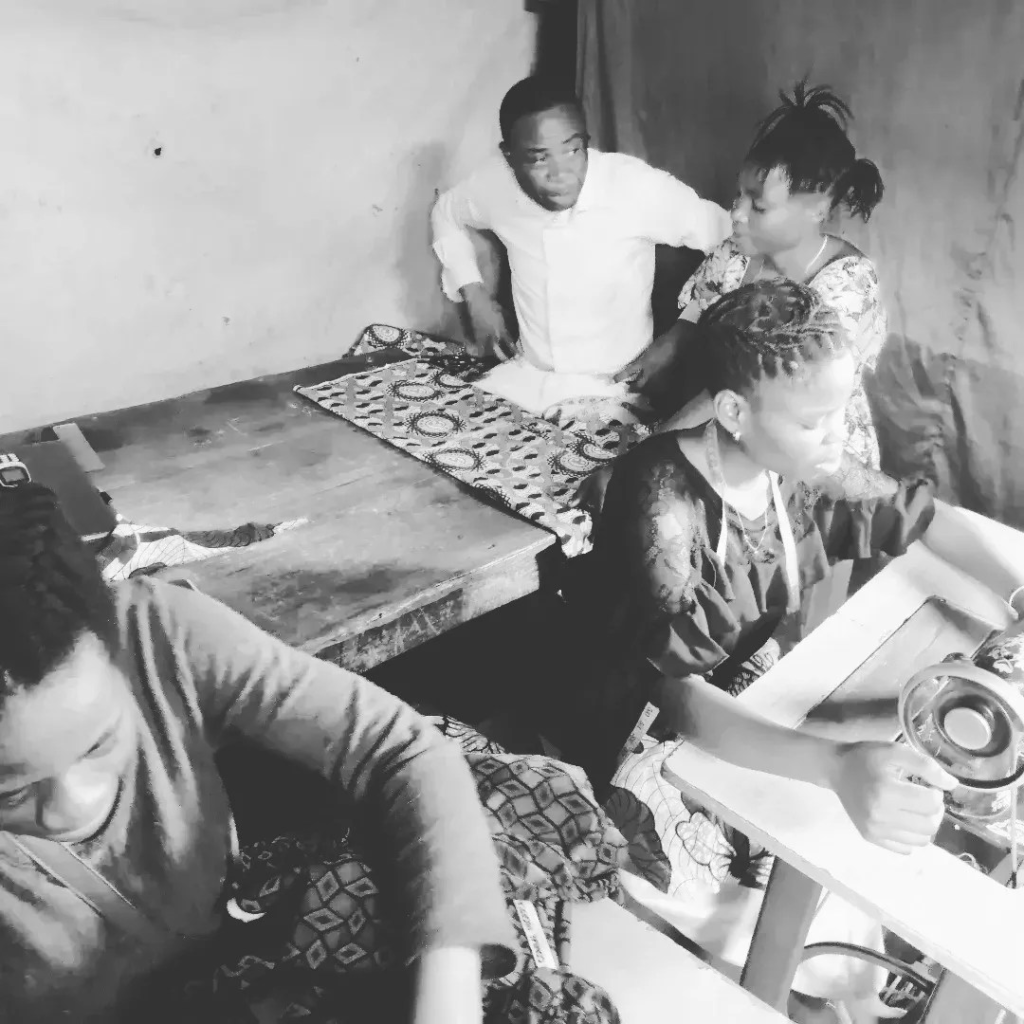
After the formalities, we were shown a room with a sewing machine and some patterns and some beautiful African fabrics. We saw a box of shirts that we would deliver to children attending school at a refugee camp (whether to attend school is a parental choice). We were also shown a box of reusable menstrual pads that have been a big success in the local community.

The box of shirts went to the car with us.

Next we were driven to another building where 6 sewing machines were set up with 6 workers in a rented space on a second floor. There were 4 or 5 older women by a table of supplies. (By the way, I don’t think I met another caucasian person during my time in Goma. These are Africans, teaching and helping other Africans.) The older women were there as teachers. They looked at us with closed faces and uncertainty. All of them were dressed in beautiful clothes they had made themselves with beautiful fabrics. They softened a bit when I asked about and praised their clothes. There were 3 former child soldiers and 3 young women at the machines.

As Bienve spoke with my son about the operation, I decided this would be a good time to disperse some of the gifts I had brought. I pulled out a scarf, a pair of glasses, a few other items. I thought I had found some wise and generous women who would know who needed what. And I had …but Bienve stopped me and explained that these women were not associated with the refugee camp, that we would find a way to give away my treasures there. Embarrassed, I took the items back and put them back in my backpack. The women, however, understood. They had seen the intentions of my heart and they smiled at me warmly. As we left them, I touched my hand to my heart and to each of theirs, going down the row, down the stairs and back to the car.

We drove through Goma toward the camp.

Would you like to get blog posts sent directly to your email inbox? Subscribe below.

Smiling from the Heart

The Africa Posts

I have left the DRC (Congo). I have left Africa. I am grateful to be heading home. My last day of travel to the airport in Rwanda was overshadowed by a mild case of food poisoning which sapped my strength. Better now as I write from my last layover.

My last 2 days in Congo were more impactful than I can express with words. However, I need to finish telling my story to the best of my ability.

I cannot say I am happy to leave Africa. I have fallen for the Congolese people. And for the refugees who now live in Goma.

What I offered to Uganda and Congo was my love. My son brought wisely placed funding, but all I had was love. On drives people were surprised to see our faces. I smiled at them with all my heart. Often people who looked hard at first – gave in to my sustained smile and returned it. It was a delight each time I broke through. In Uganda it was about 75%, but in Congo more like 30%. At first I thought it was because they had not seen whites before, but my son explained this was not the case. They have encountered whites significantly more often in Congo.

They are more wary.

Children are much quicker to meet me in my smile, but in Congo, there were some tough ones. One girl I specifically remember who would not give in comes to mind. I was standing by the van we arrived in at the first refugee camp, waiting for my son. He and Bienve had climbed a hill and looked over some gardens. This girl, maybe 9 or 10, lingered after the other children I was talking to were dispersed by a man who, it turned out, wanted to ask me for money.

As I waited for my son, leaning against the van with the photographer and 2 protectors (who were once taken as child soldiers), I smiled occasionally at the girl. She barely met my eyes, sustaining a sullen look of something like belligerence. Finally Bienve and my son returned, and as I walked around the van, I smiled again at the girl and saw for an instant the flash of a smile.

These smiles I have received are my richest souvenirs. Though I cannot display them, they live within me.

Deep thanks to Julie, who created this website for me. She posted these posts about my journey while I was away. See info about Julie in the footer at the bottom of the page.